


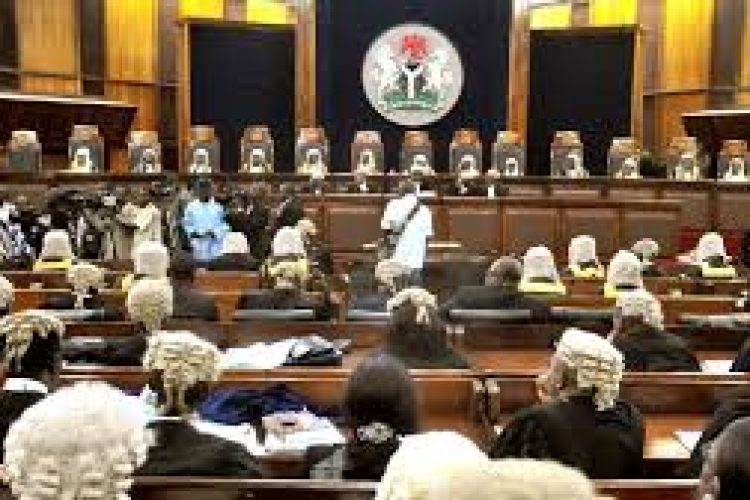
A five-member Supreme Court panel led by Justice Ibrahim Saulawa has unanimously allowed an appeal by the Economic and Financial Crimes Commission and restored the final forfeiture to the Federal Government of seven properties and $2.45 million in cash linked to former Central Bank of Nigeria Governor Godwin Emefiele, setting aside a June 2025 Court of Appeal judgment that had ordered a retrial.
The Supreme Court has allowed an appeal by the Economic and Financial Crimes Commission (EFCC) and restored the final forfeiture to the Federal Government of seven properties, $2.45 million in cash, and share certificates linked to former Central Bank of Nigeria (CBN) Governor Godwin Emefiele.
A five-member panel led by Justice Ibrahim Saulawa delivered the unanimous judgment on 17 July 2026, setting aside a June 2025 decision of the Court of Appeal, Lagos Division, which had nullified the forfeiture and ordered a retrial.
What happened
The apex court reaffirmed the original final forfeiture order made by the Federal High Court, Lagos, on 1 November 2024 in suit FHC/L/MISC/500/24. That order had followed an earlier interim forfeiture and directed that the listed properties, cash, and share certificates be permanently forfeited to the Federal Government.
The properties affected are: two duplexes on Hakeem Odumosu Street, Lekki Phase 1; a parcel of land on Oyinkan Abayomi Drive, Ikoyi; a bungalow and a four-bedroom duplex in Ikoyi; an industrial complex under construction on 22 plots of land in Agbor, Delta State; eight apartment units on Adekunle Lawal Road, Ikoyi; and a duplex on Bank Road, Ikoyi. The EFCC had also listed $2.45 million in cash and share certificates as part of the assets linked to Emefiele in the proceedings.
Which court, and the parties
The matter reached the Supreme Court as an appeal by the EFCC against the Court of Appeal, Lagos Division's June 2025 judgment. That judgment had nullified the Federal High Court's November 2024 forfeiture order on the ground that parties who claimed an interest in the properties had not been given a fair hearing before the forfeiture was made final, and it remitted the matter for retrial.
The Supreme Court panel found that this fair-hearing ground could not stand, and restored the Federal High Court's original forfeiture order. Godwin Emefiele, the former CBN Governor, was the respondent in the proceedings before the Court of Appeal and the Supreme Court.
Legal significance
The proceedings arise under Nigeria's non-conviction-based (civil) asset forfeiture regime, most commonly applied by the EFCC under provisions of the Advance Fee Fraud and Other Fraud Related Offences Act and the EFCC Establishment Act, which permit the state to seek forfeiture of assets reasonably suspected to be proceeds of unlawful activity through a civil process, independent of any criminal trial or conviction. This is a distinct legal track from criminal prosecution: a civil forfeiture order determines the status of specific assets, not the criminal guilt or innocence of any individual. The Supreme Court's judgment in this matter accordingly settles the forfeiture question — it is not, and should not be read as, a finding that Emefiele has been convicted of, or found guilty of, any criminal offence.
Under Nigeria's forfeiture procedure, an interim forfeiture order is typically made ex parte, followed by a period within which any person claiming an interest in the property may show cause why the order should not be made final. A final forfeiture order follows if the court is satisfied that no valid claim has been established or that the statutory conditions for forfeiture are met. The Court of Appeal's June 2025 intervention had turned on whether that fair-hearing opportunity had properly been afforded to interested claimants before the Federal High Court made its order final. The Supreme Court held that the Court of Appeal erred in setting aside the forfeiture order on the fair-hearing ground and in directing a retrial.
What happens next
The Supreme Court's judgment has restored the Federal High Court's forfeiture order of 1 November 2024, making it the final and binding decision on the matter. The ruling effectively brings the litigation to an end.