


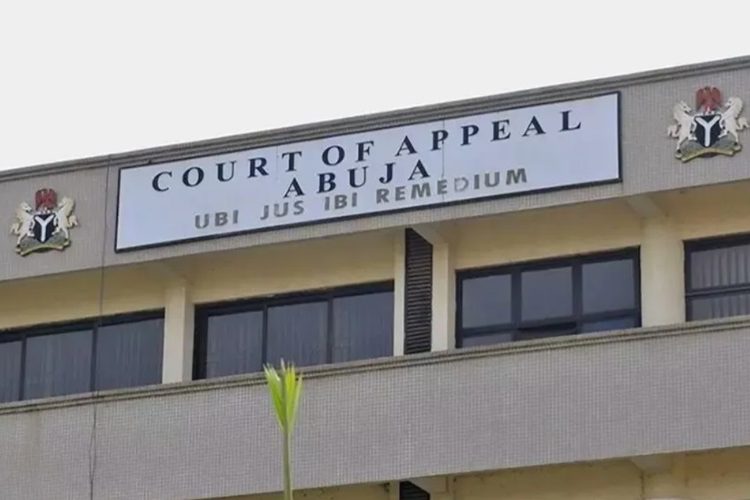
The Abuja Court of Appeal has stayed the Federal High Court’s deregistration order against five opposition parties, ruling that the trial judge delivered judgment after an appellate stay of proceedings was already in force.
The Court of Appeal, Abuja Division, has ordered the Independent National Electoral Commission (INEC) to suspend enforcement of a Federal High Court judgment directing the deregistration of five political parties, after finding that the trial judge delivered that judgment in breach of a subsisting appellate stay of proceedings.
The five parties affected are the African Democratic Congress (ADC), Accord Party, Action Peoples Party (APP), Action Alliance (AA) and Zenith Labour Party (ZLP). The stay of execution, granted on 16 June 2026 by a panel led by Justice Abba Mohammed, keeps the five parties registered and bars INEC from any step toward removing them from the register of political parties pending the determination of the substantive appeal.
The underlying suit was filed by the National Forum of Former Legislators, which asked the Federal High Court to determine whether INEC was constitutionally obliged to deregister parties that had failed to meet the electoral-performance thresholds in Section 225A of the 1999 Constitution (as amended). That provision allows INEC to deregister a party that fails, among other things, to win at least 25 percent of the votes cast in one state in a presidential election, or to secure at least one seat in a National or State Assembly election. Justice Peter Lifu of the Federal High Court ruled for the claimants and directed INEC to deregister the five parties.
Before that judgment, the Court of Appeal had on 22 May 2026 made an order staying further proceedings at the Federal High Court pending the appeal. Counsel for some of the affected parties drew Justice Lifu’s attention to that order when the matter came up for judgment and asked him to stand the matter down. He declined and proceeded.
Granting the stay, the appellate panel addressed the trial judge’s conduct in direct terms. The court held that Justice Lifu had exhibited “judicial rascality” and described his decision to proceed in defiance of the stay as “the highest form of judicial impertinence."
The principle at stake is foundational to the court structure. Counsel for the affected parties argued that a stay of proceedings issued by a superior court is binding, not a request, and that any ruling delivered while such a stay subsists is liable to be set aside for want of jurisdiction. That jurisdictional question is among those the Court of Appeal will determine at the substantive hearing.
For INEC, the practical effect is a court order to maintain the status quo. It cannot initiate deregistration against any of the five parties, and counsel for the affected parties have warned that any administrative step taken in reliance on the Federal High Court judgment while the stay subsists could expose the commission to contempt proceedings. INEC had, before the appellate order, reportedly sought a stay of execution of the Federal High Court ruling itself, a position that aligned it with the affected parties on the procedural question.
The substantive question — whether the five parties met or failed the Section 225A thresholds — remains undecided. The Court of Appeal has listed the appeal for hearing on 27 October 2026. Any final ruling on the parties’ registered status after that hearing would take effect well within the lead-up to the 2027 general elections, bearing on ballot access for those polls.