





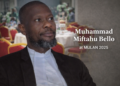


This profile is based on responses to questions submitted to the subject and has been editorially synthesised for clarity and institutional record.
In professional associations, leadership is often most visible not in rhetoric, but in continuity—showing up, sustaining institutions, and interpreting change through ethical responsibility rather than novelty. At the 2025 Annual General Conference of the Muslim Lawyers Association of Nigeria (MULAN) in Ilorin, Sunusi Lawan Fandubu attended in his capacity as Chairman of the Kano State Chapter and head of its delegation.
His reflections on the Conference are neither celebratory nor expansive. They are measured accounts of participation, institutional duty, and the pressures confronting faith-informed legal practice as technology reshapes professional life.
Role and Moment
MULAN’s annual conference functions less as an exceptional gathering than as a recurring institutional rhythm. For Fandubu, attendance is part of a professional routine—an opportunity for deliberation, cohesion, and renewal within the association. His presence in Ilorin was defined by responsibility rather than prominence: coordinating the Kano delegation and participating in the collective life of the conference.
On the 2025 theme—Artificial Intelligence, Law, and Religion—his assessment remained cautious. He described the sessions as educative and interactive, noting that the value of the conference lay more in shared learning than in definitive conclusions. A keynote address delivered by Isa Ali Pantami stood out for him, particularly in its insistence that ethical and religious perspectives remain present in discussions about emerging technologies.
Formation Without Myth
Born in 1969 in Kano, Fandubu’s path into the legal profession was not marked by early immersion or accelerated progression. He obtained his law degree from Bayero University, Kano, and was called to the Nigerian Bar in 2013. By his own account, his professional formation was gradual, shaped by steady engagement rather than immediate visibility.
Over time, involvement in a faith-based legal organisation led to increasing responsibility within MULAN Kano, culminating in his current role as chapter chairman. The trajectory reflects the accumulation of duty rather than the pursuit of distinction.
Participation as Exposure
Under his leadership, the Kano delegation participated across multiple sessions at MULAN 2025. Fandubu frames this participation not in terms of recognition or standing, but as exposure—particularly for younger lawyers within the branch.
National gatherings, in his view, serve an internal function. They allow less-experienced members to encounter broader professional debates and observe senior colleagues operating within deliberative settings. Participation, here, is formative rather than competitive.

Ethics and Technology
When reflecting on how MULAN Kano is responding to the intersection of artificial intelligence, legal ethics, and religious obligation, Fandubu emphasises practice over theory. He points to seminars, workshops, and symposia organised for members, especially younger lawyers, as practical avenues for engagement.
Beyond formal training, he repeatedly returns to moral discipline. Technology, he suggests, amplifies temptation as much as efficiency. For that reason, ethical restraint becomes more—not less—necessary in the digital age. Professional conduct, in his framing, cannot be outsourced to tools or systems.
Institutional Life Beyond Conferences
Under his chairmanship, MULAN Kano has sustained activities that blend professional development with spiritual reflection. He cites a recent Ramadan lecture and prayer session organised for newly appointed High Court Judges and Khadis of the Kano State Shari’a Court of Appeal, conducted in collaboration with the International Federation of Women Lawyers (FIDA), Kano Chapter.
Such engagements, he observes, reinforce the view that professional life and moral reflection need not occupy separate institutional spaces.
Incremental Priorities
Looking ahead, Fandubu identifies modest but concrete priorities for the Kano chapter: securing a permanent secretariat and a dedicated vehicle to support programmes. Alongside these logistical aims, he places emphasis on mentoring structures for young lawyers and the gradual integration of discussions on technology and ethics into continuing education.
The approach is incremental. Stability and continuity are treated as achievements in themselves.
Counsel and Afterlife
To young Muslim lawyers and law students, his counsel is brief and unembellished: study diligently, maintain honesty, and allow religious principles to inform professional conduct. Law, as he frames it, is not only advocacy, but responsibility.
As MULAN 2025 recedes into institutional memory, his concern is less with the Conference itself than with its afterlife. Discussions and presentations, he argues, acquire meaning only when translated into daily conduct within chambers, courts, and communities.
For Fandubu, leadership lies not in visibility, but in ensuring that reflection survives beyond the conference hall.