





More than any other field, intellectual property law exposes the tension between Nigeria’s inherited legal forms and its lived creative practices. It sits at the uneasy junction of creativity and commerce, authorship and ownership, innovation and regulation—asking the law to give form to ideas, expressions, and labour that are often intangible, communal, and culturally embedded.
In this sense, intellectual property law occupies a peculiar position in Nigeria’s legal culture. Unlike traditional areas of law that regulate conduct already familiar to society, IP law attempts something more delicate. It seeks to translate creativity into exclusive rights, to convert cultural production into legally recognisable interests, and to impose formal boundaries on practices that have long circulated through informal norms.
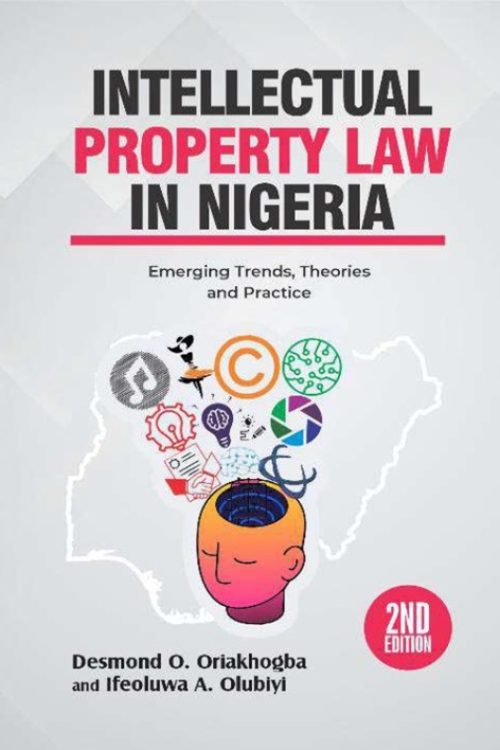
The growing body of Nigerian scholarship devoted to this field is therefore more than a technical response to piracy or commercial disputes. It reflects a deeper cultural negotiation about how value is created, recognised, and protected in a modern economy marked by scale, informality, and rapid technological change. One of the most comprehensive contributions to this conversation is Intellectual Property Law in Nigeria: Emerging Trends, Theories and Practice by Desmond O. Oriakhogba and Ifeoluwa A. Olubiyi (2nd ed., 2023).
Law and the Meaning of Creative Ownership
In many Nigerian social contexts, creativity has historically thrived outside formal legal structures. Music, storytelling, fashion, design, and informal innovation often circulate through communal expectations rather than enforceable legal claims. Intellectual property law challenges this tradition by insisting on exclusivity, authorship, and legally protected ownership.
The significance of contemporary IP scholarship lies in how it confronts this tension without reducing it to slogans about enforcement or piracy. By systematising Nigerian copyright, trademark, and patent law, works such as Oriakhogba and Olubiyi’s text invite lawyers and judges to rethink creativity not merely as cultural expression, but as a legally protected interest. This reframing carries real consequences—for how courts assess infringement, how practitioners advise clients, and how creators themselves come to understand the value and vulnerability of their work.
From Generalism to Professional Specialisation
The rise of detailed intellectual property literature also signals a cultural shift within the Nigerian legal profession itself. IP law resists casual generalism. It demands familiarity with international instruments, comparative jurisprudence, regulatory institutions, and industry-specific practices across media, technology, and innovation-driven sectors.
Reading in this area is no longer optional background knowledge. It has become a form of professional discipline, shaping how lawyers interpret ownership in non-physical assets, balance private rights against public access, and navigate disputes that sit at the intersection of law, technology, and culture. Texts that successfully bridge theory and practice, therefore, function as tools of professional formation, quietly redefining what competence and seriousness now mean in modern legal work.
In this sense, the emergence of comprehensive Nigerian IP texts marks more than scholarly maturity. It signals a field coming of age within the profession.
Intellectual Property as Cultural Mediation
Beyond doctrine, intellectual property law performs a subtle but important cultural role. It mediates between informal creativity and formal economic systems. It asks the law to recognise authorship without extinguishing cultural circulation, and to reward innovation without stifling access in a society where creative production often precedes legal recognition.
The value of serious IP scholarship lies in its ability to frame these tensions without collapsing them into advocacy or technocratic reformism. By grounding Nigerian intellectual property law in both theory and lived practice, such works equip courts and practitioners to navigate disputes that are as much about cultural meaning as they are about commercial rights.
Reading as Legal Self-Understanding
Within an Edition concerned with law’s encounter with modernity—technology, artificial intelligence, and changing forms of value—intellectual property texts stand as markers of the profession’s evolving self-understanding. They remind us that law does not merely respond to economic change; it actively shapes how society speaks about creativity, ownership, and reward.
To read intellectual property law carefully is therefore to engage in a broader cultural exercise. It is to ask how Nigerian law should understand ideas, innovation, and the moral claims of creators in a rapidly transforming world—and what it means for a legal system to take creativity seriously without losing sight of its social foundations.