

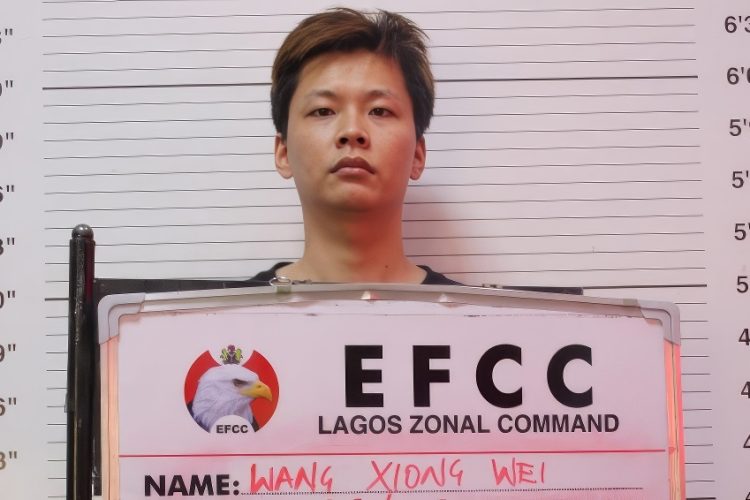
Eight Chinese nationals were found guilty of cyberterrorism and internet fraud by the Federal High Court in Ikoyi, Lagos. This is one of the most well-known convictions of foreign nationals for digital crimes in the nation. Months after the defendants were taken into custody during a massive sting operation by the Economic and Financial Crimes Commission (EFCC), Justice Chukwujekwu Aneke delivered the ruling.
The Federal High Court sitting in Ikoyi, Lagos, on Friday, July 4, 2025, convicted and sentenced eight Chinese nationals to one year imprisonment each for offences relating to cyberterrorism and internet fraud. The Economic and Financial Crimes Commission (EFCC) confirmed the convictions in an official statement.
Presiding judge, Justice Chukwujekwu Aneke, delivered the ruling after the defendants changed their initial pleas from “not guilty” to “guilty” in the course of proceedings instituted by the EFCC Lagos Zonal Directorate 1.
This judgment underscores the increasing global scope of internet fraud and Nigeria’s commitment to addressing digital threats effectively.

Convicted Persons and Case Background
The convicted individuals are Pan Cai Qi, Zeng Xian Tao, Weng Mao Rong, Wang Xiong Wei (aka Xiao Bai), Shi Dong Fu, Wang Shi Long, Liu Ke Fan, and Ting Liao.
According to the EFCC, they were part of a larger syndicate of 792 suspected cryptocurrency and romance fraudsters apprehended on December 19, 2024, in Lagos, during a sting operation codenamed Eagle Flush Operation.
Charges, Pleas, and Court Decisions
They faced separate charges related to cyberterrorism and internet fraud under the Cybercrime (Prohibition, Prevention, Etc.) Act, 2015 (as amended in 2024). One of the charges accused Pan Cai Qi of deliberately accessing computer systems to destabilize and damage Nigeria’s economy and social structure—a charge he and his co-defendants initially denied before reversing their pleas.
At Friday’s session, EFCC prosecutor, M.K. Bashir, urged the court to convict them in line with their new pleas. Justice Aneke accordingly sentenced each defendant to one year in prison, imposed a ₦1 million fine on each, and ordered the forfeiture of items recovered from them to the Federal Government of Nigeria.
He further directed the Comptroller-General of the Nigeria Immigration Service to arrange for their deportation to China within seven days of completing their prison terms.
Legal Context: Cybercrime Prosecution in Nigeria
This case reflects Nigeria’s increasing reliance on expanded cybercrime legislation to tackle organised cross-border digital crimes. The amended 2024 Cybercrime Act introduces stiffer penalties and explicitly targets activities designed to destabilise the nation’s digital, economic, and social order.
What’s Next?
Following their imprisonment, the convicted Chinese nationals are expected to be repatriated to China within seven days, as directed by the court. Meanwhile, the EFCC is likely to continue investigations into other suspects linked to the Eagle Flush Operation, considered one of the country’s largest cybercrime crackdowns to date.