

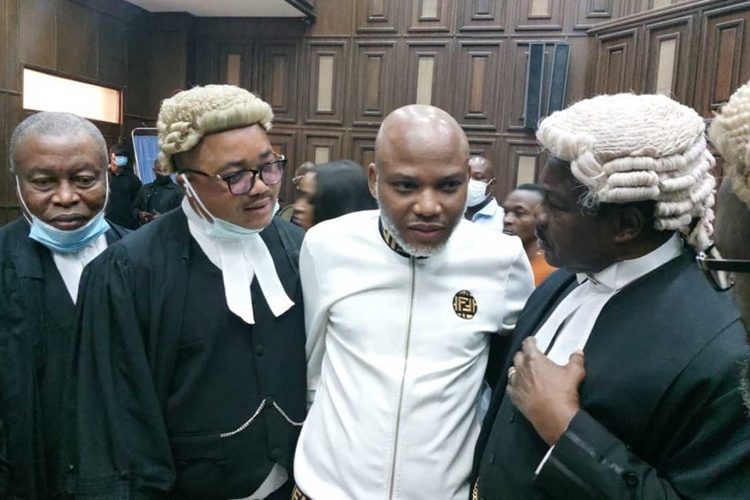
The Federal High Court in Abuja has adjourned further hearing in the trial of Nnamdi Kanu, leader of the Indigenous People of Biafra (IPOB), to May 28 and 29, with additional proceedings scheduled for June, according to a report by TVC News.
Latest Court Developments
At the latest session, a prosecution witness testified that the Western Nigeria Security Network, known as Amotekun, operates as a lawfully established security outfit under the authority of State Houses of Assembly in the Southwest. He contrasted this with the Eastern Security Network (ESN), which the prosecution associates with IPOB and alleges functions unlawfully.
Earlier, the lead defense counsel, Paul Erokoro (SAN), informed the court of delays in submitting video evidence, explaining that portions unrelated to the case had to be edited out before presentation.
To manage the trial’s pace, Justice James Omotosho directed that the prosecution must conclude presenting all its witnesses within six days, regardless of the total number. Following this, the defense will be allocated nine days to present its case. The court stressed that strict adherence to these timelines was now mandatory.
TVC News reported that after issuing these directions, Justice Omotosho adjourned proceedings to May 28 and 29, with subsequent hearings to continue in June.
“The court’s firm stance on enforcing strict timelines marks a pivotal shift in the handling of politically sensitive, high-profile trials in Nigeria.”

Legal Context: Ongoing High-Stakes Trial
Nnamdi Kanu is facing charges of terrorism, treasonable felony, and incitement — accusations that have drawn considerable public attention and international scrutiny due to the case’s political, ethnic, and constitutional implications.
A notable procedural shift in the latest sitting was the court’s emphasis on imposing clear, enforceable timelines for both the prosecution and the defense, reflecting the judiciary’s broader attempt to prevent further delays in politically sensitive trials.
What’s Next?
The trial is set to resume on May 28 and 29, with the prosecution expected to continue presenting its witnesses under the court’s new timeline directive. Legal observers anticipate that the defense will challenge the admissibility of certain pieces of evidence, particularly video materials, when their turn begins in June. The strict timeline set by Justice Omotosho will likely test both sides’ readiness and could determine how swiftly the long-running trial progresses.