






In every legal tradition, the subjects lawyers choose to write about are rarely accidental. They reveal moments of anxiety, adaptation, and transition within the profession itself. In contemporary Nigeria, few areas expose this transition as starkly as cybercrime law. More than a new field of regulation, cybercrime law forces Nigerian lawyers to confront the limits of inherited legal habits in a world where harm, evidence, and jurisdiction are increasingly intangible.
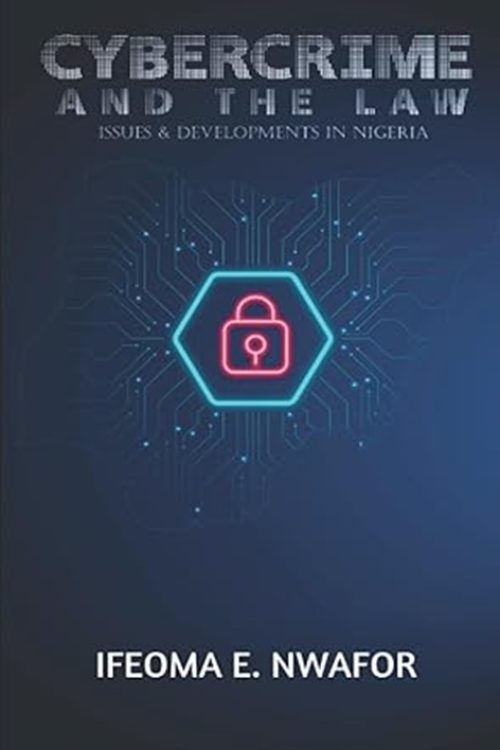
The emergence of specialised Nigerian texts on digital offences, electronic evidence, and transnational cyber regulation, therefore, signals more than professional curiosity. It marks a deeper cultural shift in how the legal profession understands crime, proof, and responsibility in a digitised society. One such work is Cybercrime and the Law: Issues and Developments in Nigeria (2022) by Dr. Ifeoma E. Nwafor. Its importance lies not only in doctrinal coverage, but in what its existence represents: a profession recognising that its traditional categories are no longer sufficient.
Law Beyond the Physical Courtroom
For much of Nigeria’s legal history, criminal law evolved around physical acts, tangible evidence, and territorially bounded harms. Crime was something seen, heard, and located. Cybercrime unsettles all three assumptions. Digital offences often leave no visible crime scene, rely on electronic traces rather than eyewitnesses, and routinely transcend national borders.
A legal system trained primarily in analog reasoning must therefore relearn how to see. It must develop new instincts for interpreting data, weighing electronic evidence, and assigning responsibility where causation is diffused across networks and platforms. Dr. Nwafor’s work enters this space as part of a broader professional recalibration—one that treats digital competence not as a technical add-on, but as central to criminal justice itself.
This emerging reading culture compels Nigerian lawyers to engage seriously with electronic evidence as a core evidentiary concern, to treat international instruments as practical tools rather than abstract references, and to understand capacity-building not as a policy slogan, but as a jurisprudential necessity.
From Generalism to Technical Depth
The rise of cybercrime scholarship also reflects a quiet but consequential shift in Nigerian legal culture. Traditional professional identity prized breadth and adaptability. Increasingly, however, competence is being redefined by depth in technically demanding areas where intuition alone no longer suffices.
Cybercrime law sits at the forefront of this transformation. It demands fluency not only in statutes and procedure but also in how technology mediates conduct, proof, and power. This has direct implications for how judges are trained to evaluate evidence, how prosecutors conceptualise digital harm, and how defense counsel safeguard procedural rights in technology-driven investigations.
In this sense, texts like Dr. Nwafor’s function less as academic contributions than as instruments of professional reorientation. They mark a field moving from marginal concern to central necessity within Nigerian criminal justice practice.
Cybercrime Law as Institutional Self-Examination
Beyond practice, cybercrime law performs a deeper institutional role. It forces the legal system to examine its own assumptions about fairness, surveillance, privacy, and global cooperation. In a jurisdiction where enforcement capacity, cross-border coordination, and digital literacy remain uneven, these questions are not abstract—they go to the credibility of the justice system itself.
Serious cybercrime scholarship matters because it frames these challenges without collapsing into alarmism or technological determinism. By grounding digital offences within Nigeria’s legal and institutional realities, such works help the profession navigate a terrain where innovation and vulnerability advance side by side.
Reading as Professional Responsibility
Within a special event edition concerned with artificial intelligence, law, and religion, cybercrime texts serve as reminders that technological change tests more than legal technique. It tests moral judgment, institutional confidence, and the profession’s ability to remain intellectually honest about its own limits.
To read cybercrime law seriously, then, is not merely to master new statutes or procedures. It is to participate in the profession’s ongoing effort to remain credible, fair, and relevant in a world where crime no longer respects physical boundaries—and where the law must learn to see what it can no longer touch.